








Types of Machine Learning Models

Carlos Salas
Portfolio Manager and Data Scientist
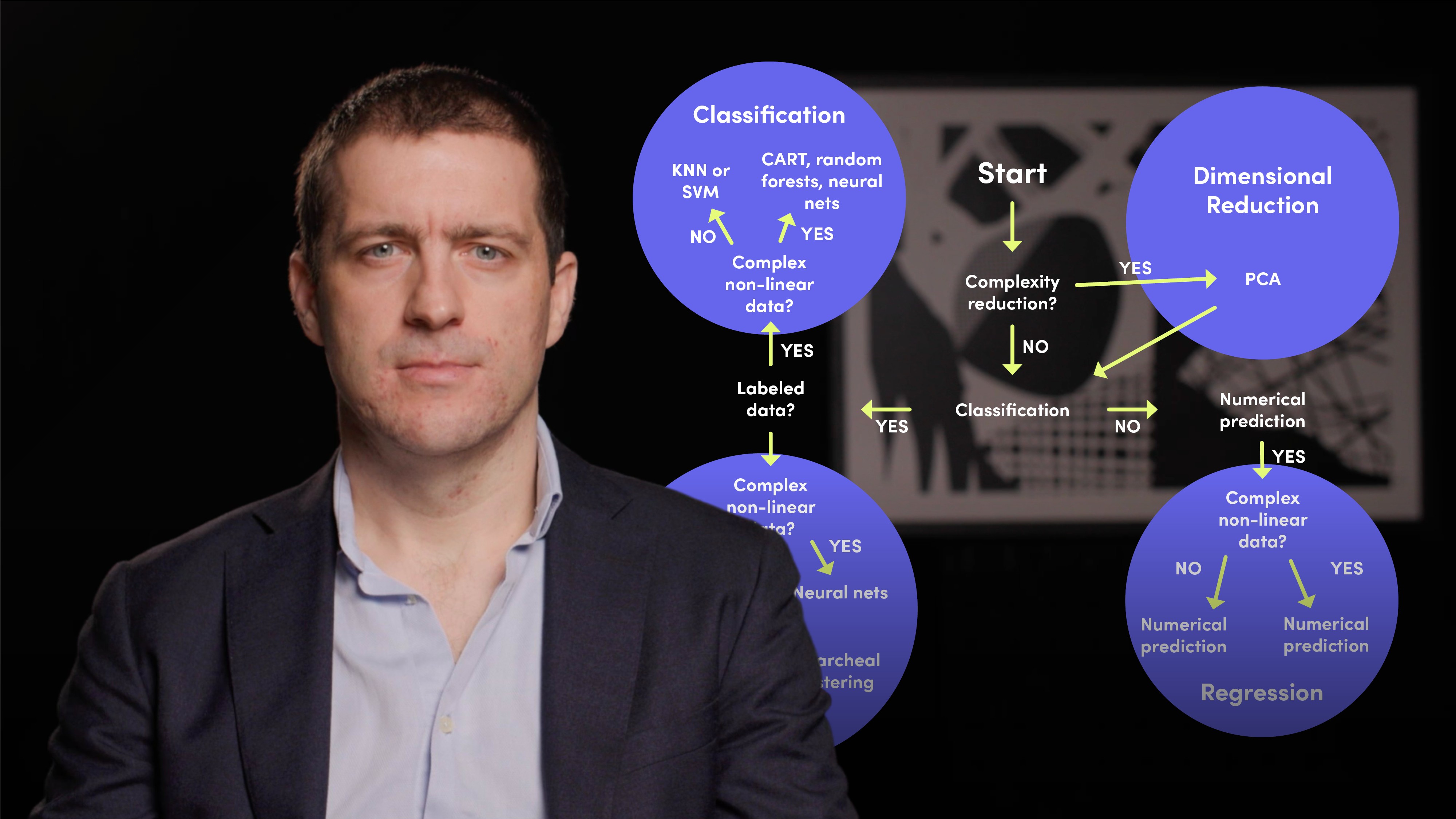
The choice machine learning model is dependent on the specifics of the problem and the data at hand. Join Carlos Salas as he guides you through the differences between supervised and unsupervised machine learning models, including principal component analysis, generalised linear models and support vector machines.

The choice machine learning model is dependent on the specifics of the problem and the data at hand. Join Carlos Salas as he guides you through the differences between supervised and unsupervised machine learning models, including principal component analysis, generalised linear models and support vector machines.
Subscribe to watch
Access this and all of the content on our platform by signing up for a 7-day free trial.
Types of Machine Learning Models
9 mins 5 secs
Key learning objectives:
Define a model
Understand the difference between supervised and unsupervised models
Outline how different models can solve the same problem
Skills:
Overview:
Broadly speaking, a model is a simplified representation of reality. The researcher always tries to develop a model that can either represent reality accurately or, at the very least, determine a set of conditions or assumptions that will allow them to control the testing of the model as scientists do in laboratories. There are two main types of machine learning models: supervised and unsupervised. We have to pick the right tool for the job when dealing with complicated financial datasets.
Subscribe to watch
Access this and all of the content on our platform by signing up for a 7-day free trial.
What is a model?
A model is a simplified representation of reality. The researcher always tries to develop a model that can either represent reality accurately or, at the very least, determine a set of conditions or assumptions that will allow them to control the testing of the model as scientists do in laboratories.
In the context of machine learning, a model is the output of a machine learning algorithm run on data that represents what was learned by the machine learning algorithm.
What is the difference between supervised and unsupervised models?
Supervised learning models infer patterns between a set of inputs, such as predictors or features, and the desired output response or target variable. These models are provided with historical data for both input and output variables in order to find the relationship that has the best predictive power for the sample data. One example would be a supervised linear logistic classification model that can predict the response “regime of the stock market” as a binary outcome “bull or bear” using as features a group of macroeconomic variables.
Unsupervised learning algorithms examine the dataset and identify relationships between variables and their common drivers. In other words, they try to unveil the structure of the data. As an example, we may take market returns and try to identify the main drivers of the market. A useful unsupervised model could classify stocks in groups depending on how close their embedded predictors move together, instead of using more rigid methodologies like region or industry classification.
Subscribe to watch
Access this and all of the content on our platform by signing up for a 7-day free trial.

Carlos Salas
There are no available Videos from "Carlos Salas"